


Most brands don't lose because the product is bad. They lose because buyers can't tell why this option fits them better than the others.
That's where value positioning comes in. In simple terms, it answers one question: why should a specific customer choose you instead of someone else? A value proposition is the promise you make. Value positioning is how you place that promise against other choices in the market.
In crowded categories, clear beats clever every time. When people understand your value fast, they trust you faster too. Let's make that happen.
Start with the customer problem you solve best
Strong value positioning starts with focus. If you try to speak to everyone, your message turns into wallpaper.
People buy when they feel seen. They want to know you understand their pain, the result they want, and why now matters. That could be a missed deadline, wasted budget, slow reporting, or too much manual work. The trigger matters because it shapes what "value" means.

Choose a specific audience, not everyone with a pulse
A narrow audience makes your position stronger, not smaller. That sounds backward at first, but it works.
Think about the difference between "project software for teams" and "project software for in-house marketing teams with tight deadlines." The second one feels real. It creates a picture. It also hints at a better fit.
Good audience choices often sound like this:
- Busy professionals who need quick decisions
- Budget-conscious buyers who want lower risk
- Small teams that need to save time every week
When you name the audience well, your message gets more believable.
Focus on outcomes people care about, not product features
Features matter, but buyers don't wake up wanting features. They want a better day.
"AI tracking" is a feature. "Helps you spot problems sooner and make faster decisions" is the value. "Automation" is a feature. "Saves five hours a week" is the outcome.
This quick comparison shows the difference:
| Feature | What the buyer cares about |
|---|---|
| AI alerts | Finds issues before they become expensive |
| Workflow automation | Cuts manual work each week |
| Custom dashboards | Makes reports easier to read |
| Fast onboarding | Gets the team productive sooner |
The takeaway is simple. Translate every feature into time saved, money kept, stress reduced, or results improved. That's where value positioning gets sharp.
Build a value positioning statement that is clear and easy to prove
Once you know the audience and their problem, you can turn that into a clear statement. This is not the place for slogan energy. It's the place for plain words.
The best value positioning statement is short, clear, and easy to repeat. If your sales team can't say it without tripping over it, rewrite it.
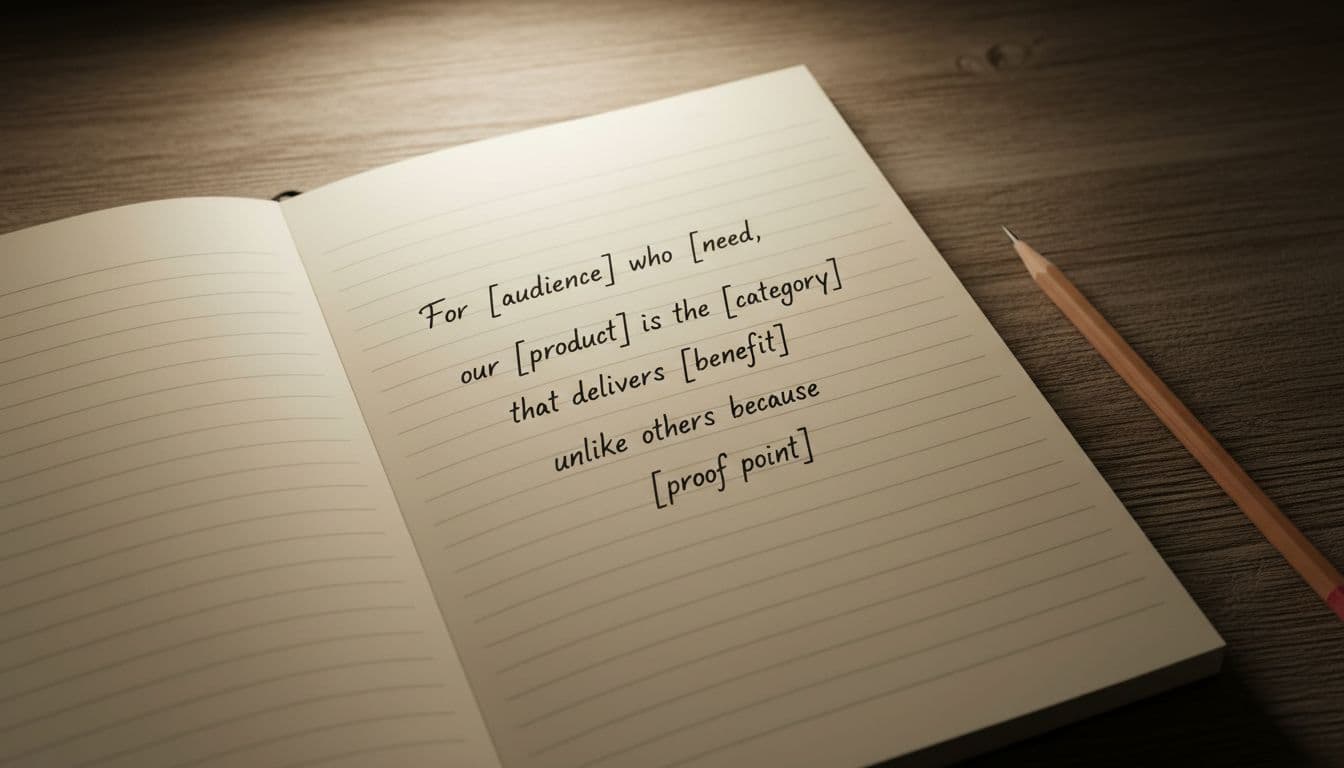
Use a simple formula to say who it is for, what it does, and why it wins
A practical structure works better than a fancy one:
For [audience] who [need], our [product] is the [category] that delivers [main benefit], unlike other options because [proof].
For example, say you sell finance software. A weak line is, "We help businesses transform reporting." A stronger one is, "For small finance teams that need monthly reporting done faster, our software is the reporting tool that cuts manual spreadsheet work by half, because it pulls data from all your systems automatically."
That's longer than a tagline, but that's okay. You can tighten it later. First, get the meaning right.
If your message could sit on a competitor's homepage without anyone noticing, it's too generic.
Back up your claim with proof customers can trust
Proof turns positioning from talk into trust. Without proof, even a good claim feels thin.
Useful proof can come from customer results, side-by-side speed, lower cost, stronger retention, better service, or a tighter fit for a niche. In 2026, that proof matters more because buyers are looking harder at long-term value, not only sticker price. Recent retail trend reports show more buyers care about durability, resale, easy returns, and total cost over time.
That means your proof might be "set up in one day," "used by 300 accounting teams," or "cuts rework by 28%." It might also be "lasts longer," "costs less over a year," or "gets higher renewal rates."
Avoid puffy claims like "best in class" or "industry-leading" unless you can show why. Otherwise, they sound like a movie trailer voice-over with no movie behind it.
See where competitors are weak, so your value positioning stands out
Value positioning is relative. You don't build it in a vacuum. You build it against what buyers already compare.
That doesn't mean you need to trash competitors. It means you need to understand the choice set. If a buyer is comparing speed, support, risk, and price, your message should show where you win on those points.

Map the choices your customer is already comparing
Most brands think only about direct rivals. Buyers don't.
They compare three things:
- Direct competitors that sell a similar product
- Indirect competitors that solve the problem another way
- Doing nothing, which often feels safest
That last one gets ignored all the time. Yet "keep the old system for now" is often your real competitor. So your message must beat inertia too.
For example, if you sell a premium tool, your buyer may compare you to a cheaper tool, a manual spreadsheet, or no change at all. Each option needs a response.
Look for gaps others ignore, then make that your edge
The strongest angle is often hiding in plain sight. Maybe others brag about feature count, while buyers care about easy setup. Maybe the market talks about power, while customers want less risk.
Common gaps include better support, faster launch, simpler use, stronger results, or a tighter fit for one niche. Niche fit is often underrated. A product that feels built for one type of buyer can beat a larger player that feels broad and generic.
Avoid the mistakes that make value positioning sound weak
Even good products get buried under weak wording. Usually, the problem isn't the offer. It's the message wrapped around it.
Stop using vague claims that could describe any brand
Words like "high quality," "innovative," and "customer-first" don't say much on their own. Nearly every brand says them. That makes them invisible.
Specific language works better because it paints a clear picture. "Replies in under two hours" beats "great service." "Designed for solo consultants" beats "built for modern professionals." "Cuts onboarding from three weeks to three days" beats "efficient solution."
The more concrete your claim, the easier it is to trust.
Do not lead with mission if the value is still unclear
Mission matters, but it can't carry the whole message. Buyers usually want the practical benefit first.
That means your homepage should not open with a grand statement about changing the future if the visitor still doesn't know what you do. Lead with the customer outcome. Then support it with your mission, values, or story.
A strong mission can deepen loyalty. Still, clear value gets you invited to the conversation in the first place.
Turn your value positioning into messaging your team can use everywhere
A strong position should travel well. It should work on your homepage, in sales calls, in ads, and in customer support.
That doesn't mean every channel uses the same sentence. It means every channel carries the same idea. Buyers remember what repeats. Teams move faster when they aren't inventing a new message every week.
Adapt the core message for your website, sales, and content
Start with one core statement, then shape it for the channel.
On a homepage, lead with the big outcome. On a sales call, add proof and objections. In an ad, focus on the sharpest pain point. On product pages, connect features to results. In content, teach the problem and show your approach.
For example, a project tool for agency teams might say this on its homepage: "Keep client work moving without status-chaos." In sales, that becomes: "Teams cut update meetings by 30% because everyone sees project status in one place." Same position, different format.
Consistency matters because people need repetition before they remember you.
Review and refine your message as the market changes
Value positioning is not a stone tablet. Markets shift. Competitors copy. Buyer needs change.
So test your wording with real customers. Watch conversion rates, sales-call feedback, retention, and win-loss notes. If buyers keep asking the same confused question, your message needs work. If a competitor starts owning your angle, sharpen yours.
Clear, proof-based messaging and niche focus are beating broad claims. That trend also lines up with how AI tools and shopping assistants judge brands. They favor clean facts, strong reviews, and consistent claims across channels. If your message is fuzzy, both humans and machines move on.
Clear beats noisy. Always has.
A strong value positioning strategy doesn't try to impress everyone. It speaks to the right customer, names the outcome they want, and proves why your option fits better.
So keep it simple. Know your audience, show the result, explain your edge, and repeat that message everywhere your brand shows up.
Then take one page on your site and rewrite it today. If a stranger can read it and instantly get the value, you're on the right track.